What Are Solfeggio Frequencies?
Ask ten people what the Solfeggio frequencies are and you will get ten confident, largely incompatible answers. They are described as ancient, sacred, lost, rediscovered, and occasionally as scientifically proven. Much of that is worth setting gently to one side.
What remains is more interesting than the mythology: a small set of frequencies that many people enjoy listening to, each carrying its own modern associations and intentions.
The short version
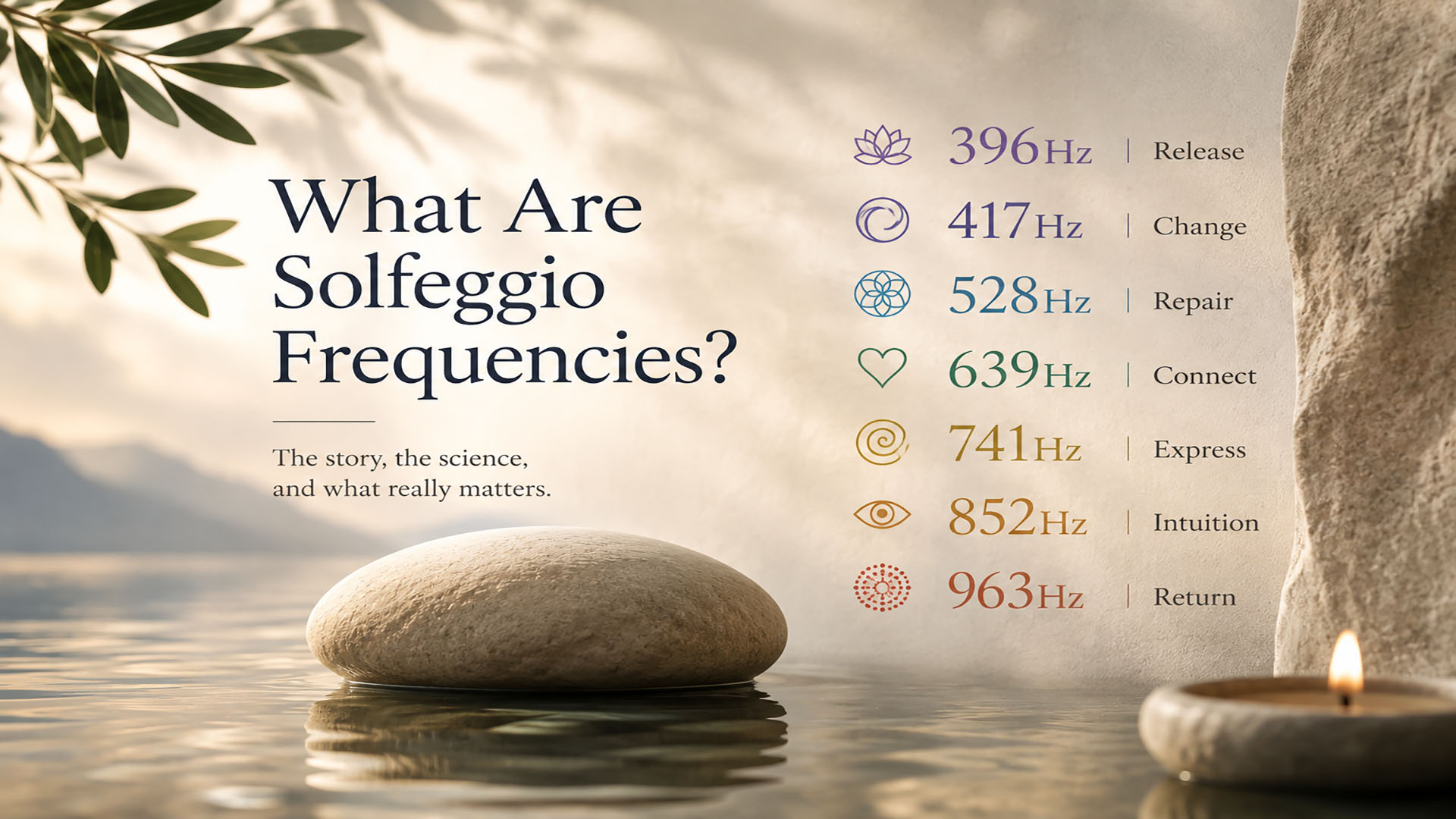
The Solfeggio frequencies are usually given as a set of six tones - 396Hz, 417Hz, 528Hz, 639Hz, 741Hz and 852Hz - often extended to nine with 174Hz, 285Hz and 963Hz.
Each is commonly associated with a particular intention, such as release, change, restoration, connection, expression or insight.
A frequency, in this context, simply describes how many times per second a sound wave repeats. Higher frequencies generally correspond to higher pitches. 440Hz, for example, is a common modern reference pitch for the A above middle C, while 528Hz sits a little above C5.
Where the name comes from
"Solfeggio" is a real and very old musical term. It refers to the sight-singing syllables - ut, re, mi, fa, sol, la - associated with Guido of Arezzo in the eleventh century and drawn from a Latin hymn to John the Baptist. That much belongs to documented musical history.
The connection between those syllables and today's specific set of frequencies in hertz is much more recent.
Hertz as a unit did not exist until the nineteenth century, and standardised concert pitch came much later than medieval solmisation. Medieval singers therefore weren't thinking in terms of precise frequencies such as 528 cycles per second.
The modern Solfeggio frequency system emerged during the twentieth century and became increasingly popular through the work of figures including Joseph Puleo and Leonard Horowitz. Its development involved numerological interpretations rather than the rediscovery of measured frequencies used by medieval musicians.
That doesn't determine whether somebody can find value in listening to them, but it does make the frequently used description "ancient healing frequencies" historically difficult to support.
What does the research say?
There is considerably less research into individual Solfeggio frequencies than you might imagine from reading about them online.
There is evidence that listening to music can help some people with relaxation and subjective feelings of anxiety and stress. Factors such as tempo, predictability, familiarity, personal preference and the circumstances in which we listen can all matter.
That research, however, isn't the same as demonstrating that an individual frequency such as 528Hz produces a unique effect.
Research specifically isolating individual Solfeggio frequencies remains limited. Studies tend to be small, and separating the effect of a particular frequency from the wider experience of sitting, resting and listening to calming audio can be difficult.
So the evidence is much stronger for the effects of music and listening itself than it is for specific claims attached to individual Solfeggio frequencies.
That doesn't make frequency-based listening meaningless. It simply helps separate the listening experience from some of the more extraordinary claims that have grown around these numbers.
Why do people listen anyway?
There are plenty of reasons to enjoy frequency-based music without needing to believe that a particular number has a medical effect.
** A sustained sound gives your attention somewhere to rest. A drone or slowly evolving piece of music can provide a simple focus without constantly demanding your attention.
** The associations can provide an intention. If you associate 639Hz with connection, for example, choosing that frequency may become a way of marking an intention before you begin listening.
** Simplicity can be useful. Sometimes deciding what to listen to is almost as difficult as switching off in the first place. Choosing a particular frequency can remove one more decision from the evening.
And sometimes you simply prefer the sound of one recording to another.
That's reason enough.
The most useful way to approach Solfeggio frequencies may therefore be as something personal and experiential rather than medical. You're choosing a sound and creating some space to listen.
How to listen
Start with a frequency you actually enjoy rather than automatically choosing the one with the most appealing description.
Keep the volume comfortable. Frequency music doesn't need to be loud to be immersive, and a lower volume will often be more appropriate for relaxation, meditation or sleep.
Give yourself enough time to settle into the recording before deciding whether it suits you. There is no required listening time and no particular frequency that everybody needs to use.
If you're curious about two of the most widely discussed frequencies, you can explore our guide to 432Hz and 528Hz.
If you're interested in one of the higher frequencies in the modern Solfeggio set, you can also read about 963Hz.
Or, rather than beginning with the theory, explore our Frequencies collection and simply listen for what suits you.
And if the number stops mattering after a while, that's perfectly fine. Sometimes the listening itself becomes more important than the theory behind it.
A note on claims
We would rather be trusted than persuasive.
You will find extraordinary claims about Solfeggio frequencies online, from healing illnesses to repairing DNA or changing external circumstances. There isn't reliable scientific evidence to support claims of that kind, and we won't present them as fact.
That doesn't mean music has to be stripped of meaning, ritual or personal significance.
What music can do - simply, and for a great many people - is make a room feel calmer, create space away from everything else competing for our attention, and give a restless mind somewhere to settle.
That seems enough to be going on with.